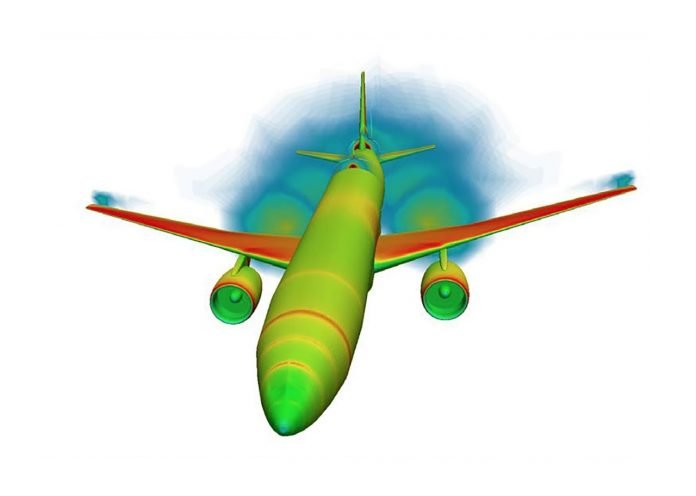
Computational fluid dynamics (CFD) simulations have become an essential tool for engineers in the aerospace industry. They are used to study the aerodynamic behaviour of aircraft and spacecraft and optimise their design. However, CFD simulations can be challenging to perform accurately, especially when dealing with complex shapes and high-speed flows.
This article will explore the role of the CFD aerospace industry and highlight some of its challenges.Why Keping Fit Should be Part of Our Fun Activities
CFDs role in aerospace engineering
CFD is used in the aerospace industry for various purposes, including:
- aerodynamic design and optimization,
- performance prediction,
- and mission analysis.
CFD can analyse an aircraft or spacecraft’s airflow behaviour under different conditions, such as altitude and Mach number. It allows engineers to design more efficient vehicle shapes that perform better at high speeds. In addition, CFD simulations can optimise an aircraft or spacecraft’s propulsion system by analysing its flow characteristics.
Finally, CFD simulations can also predict how an aircraft or spacecraft will behave during specific missions, such as takeoff and landing, enabling more accurate operations planning.Top 5 Currency Conversion Apps For Android Phones
How CFD is used to improve aircraft performance
CFD simulations examine the behaviour of air flowing over an aircraft. It allows engineers to better understand how the design will perform in different conditions, such as high-speed manoeuvring or turbulent environments. CFD can be used to identify areas of flow separation and drag creation, which leads to a decrease in performance. Engineers can use this information to optimise their designs and reduce drag, achieving greater efficiency with less fuel consumption.
CFD is also used to test various materials for structural integrity under extreme conditions. For example, testing for heat transfer through insulation can ensure good thermal properties for a given application. In addition, CFD is being used to develop new methods of propulsion and navigation, such as supersonic combustion ramjet engines and dynamic wings.
Challenges of CFD in aerospace engineering
The accuracy of CFD simulations depends on the data quality and assumptions used in the model. If the data is invalid or incomplete, then the results of a simulation could be inaccurate. Additionally, complex shapes and high-speed flows can increase the computational demands of a simulation, making it difficult to obtain accurate results promptly.
Furthermore, CFD simulations require significant computing power and expertise. Aerospace engineers need to deeply understand the physics of airflows to model them accurately. It requires expensive hardware, software, and specialised personnel for maintenance and operation.
How CFD is overcoming these challenges
Despite the challenges, CFD plays an increasingly important role in aerospace engineering. Advancements in computing power and simulation software have made it easier to accurately model complex shapes and high-speed flows. New techniques, such as meshless methods, are also being developed that can significantly reduce computational time without sacrificing accuracy.
CFD simulations are also becoming more accessible thanks to cloud computing services and open-source software. It makes it easier for companies to access the necessary computing resources and expertise without investing heavily in their infrastructure.
Examples of how CFD has been used to solve problems in the aerospace industry
CFD has been used to solve various problems in the aerospace industry. For example, NASA used CFD simulations to examine the aerodynamic performance of their X-57 Maxwell aircraft. The simulations revealed how changes to the wing design could significantly improve its efficiency and reduce drag.
Boeing also used CFD to analyse airflow around their 787 Dreamliner wings. It allowed them to identify areas where aerodynamic improvements could be made, resulting in lower fuel consumption and increased range for the aircraft.
The future of CFD in the aerospace industry
As computing power and simulation software improve, CFD will play an even more significant role in the aerospace industry. It will analyse more complex problems and optimise aircraft designs for greater efficiency. Additionally, with the increasing availability of cloud computing resources, it will become easier for companies to access the necessary expertise and hardware without needing a significant infrastructure investment.
Overall, CFD has already had a significant impact on the aerospace industry. Providing detailed simulations of how airflows interact with aircraft designs has enabled engineers to create lighter, more efficient vehicles that can travel farther than ever before. As technology advances, this trend will continue as CFD plays an increasingly important role in aerospace engineering.
Conclusion
CFD plays an increasingly important role in the aerospace industry, with its applications ranging from aerodynamic analysis to propulsion and navigation methods. It has already enabled engineers to create more efficient aircraft designs, and as computing power and simulation software improve, this trend will likely continue.
With the increasing availability of cloud computing resources, CFD simulations are becoming more accessible than ever before, making it easier for companies to access the necessary expertise and hardware without needing a significant infrastructure investment. As such, it’s clear that CFD will remain a vital tool in the aerospace engineer’s toolbox for many years.