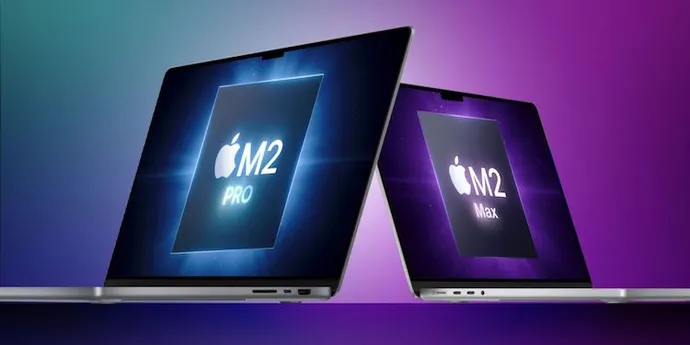
Newer laptops and desktops with M2 processors use memories spread across fewer NAND chips.
The new 14 and 16-inch Macbook Pro laptops and the Mac Mini with M2 are arriving in the hands of users and especially journalists or “tech influencers”. Among the first tests performed by the owners is the one relating to the speed of the hard drives, a rather hot topic because with the release of the latest Macbook Air and Macbook Pro 13 with M2, Apple had made some changes that had slowed down the performance of the SSDs.
The change we mentioned is the use of fewer NAND chips, the components used to make up the storage space on all computers. On models with M1 processors, the 256GB of SSDs offered as standard on most models were obtained from 2 NANDs of 128GB each. In this way it was possible to access the memories in parallel, significantly increasing the speed and also the performance, since in some cases the space on the SSD is also used to help the RAM.
With the arrival of the first Macs with M2, however, the constructive approach changed: on all the basic models of Macbook Air and Macbook Pro 13 there are no longer NANDs in parallel, replaced by a single chip. In the case of a 256GB SSD there is therefore only one component that integrates all the available memory. The processor, therefore, has to access data via only one chip and this has a major impact on the speed of SSDs.

The first tests carried out on the Mac Mini and Macbook Pro 14/16 with M2 confirmed the new approach chosen by Apple: the amount of NAND is halved not only on the Mac Mini but also on the Macbook Pro, very high-end products aimed at professionals. The single 512GB NAND present on the base configurations offers the following performances:
- Macbook Pro 14 with M1 Pro and 512GB SSD (2 x 256GB NAND): Approx. 4900MB/s Read, Approx. 3950MB/s Write
- Macbook Pro 14 with M2 Pro and 512GB SSD (1 x 512GB NAND): Approx. 3150MB/s Read, Approx. 2700MB/s Write
The difference is substantial and even if in many situations it will be difficult to notice differences, there are still common usage scenarios that can make them emerge clearly, for example moving large quantities of files. It cannot, therefore, be said that SSDs are slow in absolute terms but compared to the previous ones, and also in relation to the price at which they are offered, certainly more could have been done.
The same goes for the Mac Mini, with the difference that, in the case of the base 256GB model, the speeds are slower than the 512GB Macbook Pro, as indeed they were (proportionally) on the models with M1.
For more informational news and more, check out the Gadgetstripe news hub.