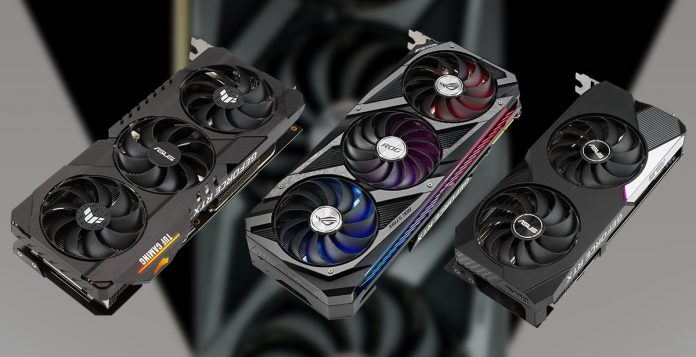
The year started a bit tough for the tech industry, as it may seem the tech industry has gradually recovered and every day, we hear good news in the industry. I’m here to bring you all some fascinating news, the one that we’ve all been waiting for is the New ROG Strix GeForce RTX 3000 Series.
As the new Ampere architecture CPU from Nvidia is out with far more performance than the previous generation and the GPU’s operate within completely new thermal and power envelopes. So, the re-designing of the ROG Strix cards starts from the ground up to unleash its full potential. Here is what new about the ROG Strix;
- The changes start with the aesthetics with the new Strix, a 2.9 slot card that looks sleeker than the 2.7 of last generation Strix and incorporates the same design language as their latest ROG Strix motherboard.
- The metal accents give the card a premium look and feel with embedded addressable RGB lightings which can be controlled via aura software to add a dash of color. In a future software update, the Strix will also be able to display GPU temperature as colour and you can also switch all the lightings off.
- The thermal solution has been re-designed to deal with the thermal footprint of Nvidia’s new Ampere GPU’s. The three major thermal solutions of the ROG Strix GeForce RTX 3000 Series are:
- The heatsink of the card has a 2.9 slot footprint that well accounted by a larger heatsink that provides 31% more surface area than the last generation design and all of the fins connected via heat pipes to the max contact heat spreader. The max contact heat spreader is machined to be flat and polished so it’s smoother at the microscopic level ensuring flusher contact with the die and because the surface flatness varies from die to die, they have utilized a custom mounting bracket to ensure good heat spreader to die contact on every card.
- With more fins and surface areas to deal with they optimize fan performance. Similar to the last generation three actual-tech fans utilize a barrier ring to increase static pressure because of the bigger heatsink a more subtle change to optimize airflow and dispersion. The two fans on the flanks now feature a narrower barrier ring while the central fan now has a wider barrier ring and 13 blades this allows the side fans to intake more air laterally without disturbing the airflow of the central fan which needs to maintain at higher static pressure because it resides directly on top of the heat spreader and the GPU. These subtle changes allowed the latest actual-tech fans to deliver more airflow while producing lower noise levels than the previous generation.
- The backplate: As you know, circulating coolers require fresh airflow to deliver optimal performance so they shorten the PCB to create a vent hole for hot air to travel through the backplate and toward chassis exhaust fans so this can prevent hot air from being recycled by the GPU.
4. As a result of increased power demands users may need to re-evaluate the power rating of their PSU’s and even if they have high power PSU that has run hard for several years, its voltage regulation may no longer be adequate to cope with the fast-fold changes which in such instances cause systems to crash when under load leaving users puzzled. To aid troubleshooting, ASUS developed an onboard circuit that monitors the PSU rail voltage and it’s fast enough to catch any transient that results in the rail voltage dropping too low, in any case, it happens, LED’s will light up to signal that your PSU wasn’t able to keep up with the current demands of the GPU.